Dashboard warning lights: what does it mean?
Similar icons can accompany different messages. The display text helps you choose the right action.
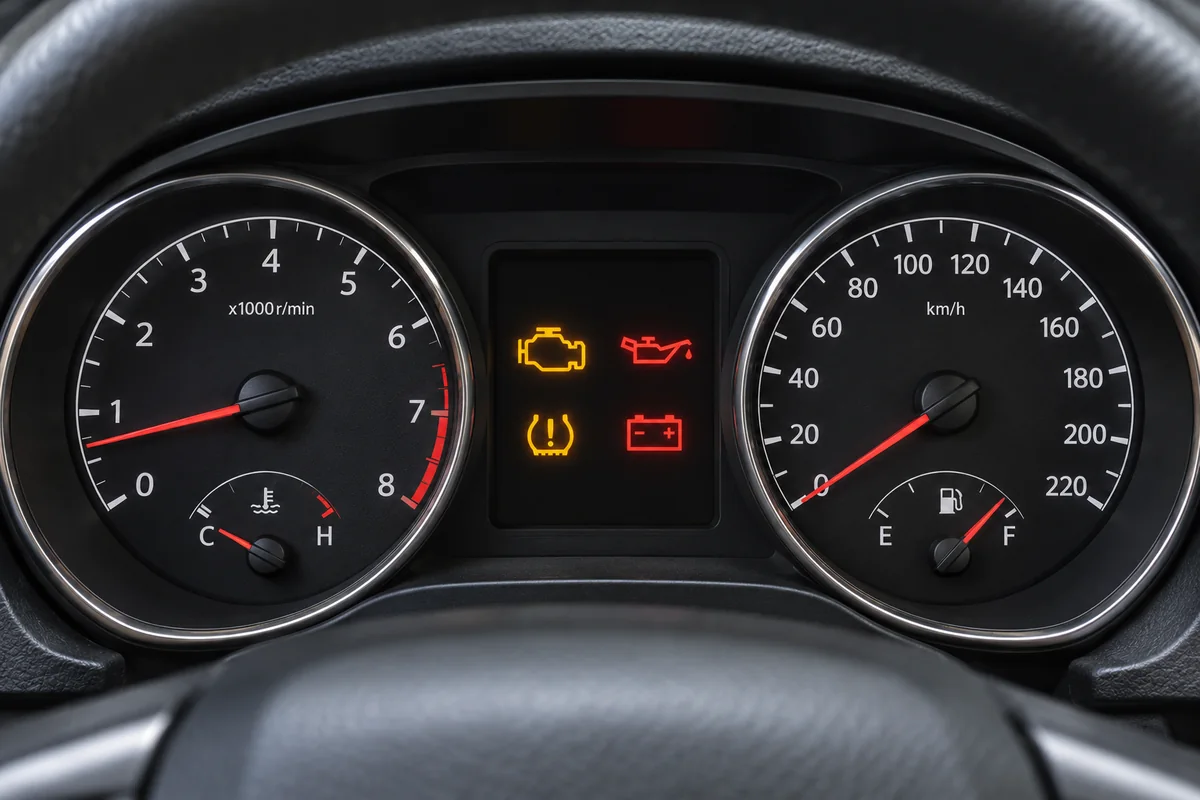
In one sentence
Dashboard lights indicate that a function is active or that the vehicle has detected something. The symbol and message determine what you should do.
What should you do when a light appears?
Check the exact symbol and read its message. Some lights briefly illuminate on startup as a check. If a message stays on or appears while driving, look it up in your car’s handbook.
Colour helps with an initial assessment but does not tell the whole story. For a serious warning such as oil pressure or braking, stop as soon as it is safe and follow the vehicle instructions. Call roadside assistance if in doubt.
Once safely stopped, note the wording and circumstances. Tell the garage whether the warning appeared on a cold start, while driving or with other symptoms. That helps more than reporting the colour alone.
An oil can on the display
A low oil level message calls for a different response from an oil pressure warning. Read the vehicle’s text and follow its handbook. Do not decide to keep driving based on the symbol alone.
Use your model’s message and handbook to determine what to do.
Recording the symbol, message and conditions
The same symbol can appear alongside different messages. Look up the combination in your model’s handbook. Flashing, a sound or accompanying text can be part of the instruction. A message that disappears can still be useful evidence of a recurring issue.
Write down the exact text when safely stopped. Record whether the engine was cold and whether you had just started, braked or accelerated. Take a photograph only while safely parked.
A dashboard photo can preserve details you might forget, such as the words beside the symbol or a second light. Take the photo only once safely stopped. Then record whether the message was still visible after the next time you started the car.
Self-test or warning during a drive
A driver notices that a light appears only while idling after a longer trip. That detail is more useful to a workshop than the colour alone. Mention any noise, temperature warning or power loss at the same time.
A lamp that appears briefly at ignition can be part of the self-test. A warning that returns during a drive needs to be interpreted for that situation.
Before buying a used car, check where its handbook is kept. Some models retain messages in a menu after a drive. Check it while safely parked and have a warning that has cleared investigated if it returns.
Follow instructions to stop or turn off the engine as soon as it is safe to do so. Wait for help if unsure. If a fault code is read, ask which test confirms the cause. The name of the code is often only a starting point for diagnosis.
Keeping the warning and diagnosis
Keep the description of the warning, the diagnosis and the repair as separate records.
Keep any diagnostic trouble code separate from the name of the dashboard light. Ask the workshop for a brief note of what triggered the code and which check confirmed it. This gives you something to compare if the same message returns under different conditions.
Frequently asked questions
Does amber always mean I can keep driving?
Colour gives context. Follow the accompanying message and the vehicle handbook.
Can I have a warning cleared?
Clearing a warning does not address the cause. Find out why it appeared first.

Keep track in Revler
Record the date and eventual diagnosis in your service history.
See it in the appSources and further reading
General information. Your vehicle handbook takes precedence for maintenance instructions.